
铁线虫
How a Chinese game scholar connects ancient texts with modern play_我的网站

一 | 8月26日下午消息,第四届“10+N”城市管理局长联席会议城市治理现代化与全域智能运营创新实践研讨会在新疆举行。
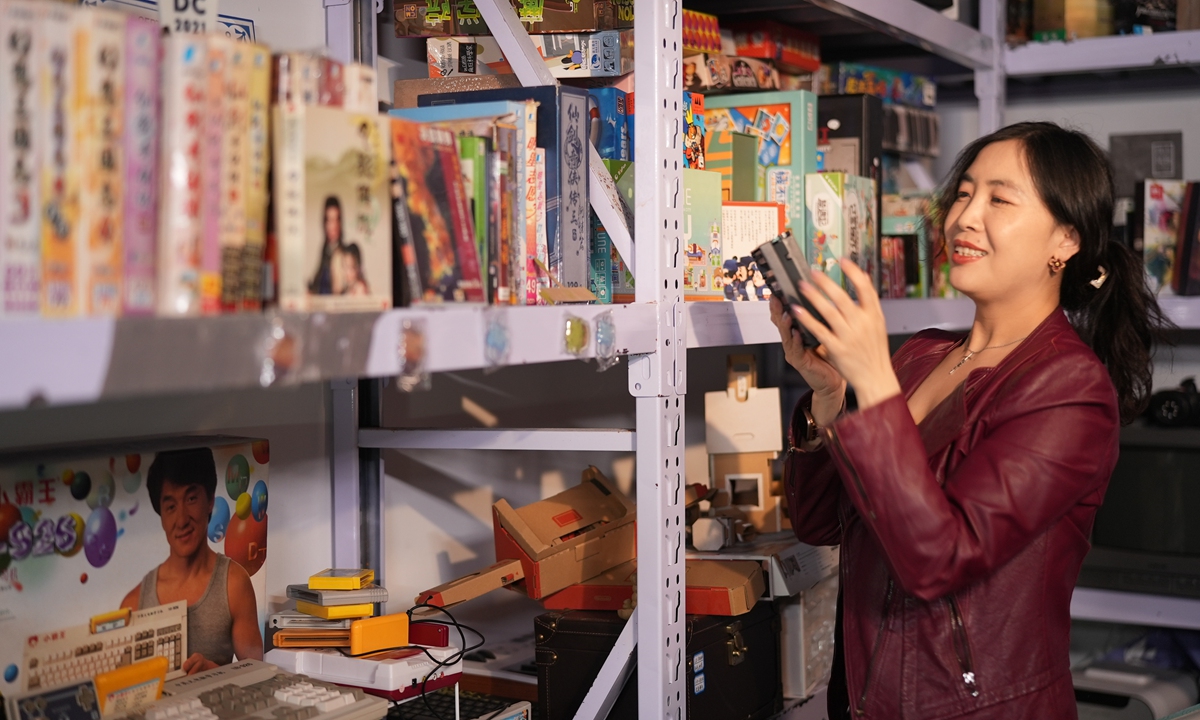
Inside Beijing's Homoludens Archive, shelves are filled with books, game consoles, game cartridges and other materials tracing the history of video games. For Liu Mengfei, the archive's director and chair of the academic committee of the Gamification Professional Committee, these collections preserve more than the evolution of games, they also capture the cultural memories of a generation.
A PhD in history from Tsinghua University, Liu has spent more than a decade studying the social impact of games, the role of games in history and digital humanities. Throughout her career, she has continued to explore the relationship between games and people: Why do humans create games? And how do games shape culture and society?
Books, meanwhile, have been an important gateway through which Liu has come to understand the world of games.
"The real value of a book lies not simply in what it tells you, but in whether it can change the way you understand the world and people," Liu told the Global Times.
Books meet games
In 2007, being an undergraduate history student, Liu wrote her thesis on the links between ancient Celtic religion and modern digital games.
To study original sources such as The Gallic War by Roman author Julius Caesar, she taught herself Latin. As her research extended into modern games, she also began reading the rulebooks of Dungeons & Dragons, a tabletop role-playing game.
"From historical texts to game rulebooks, these reading experiences seemed to belong to completely different worlds, but they gradually led me to realize that games are not simply entertainment products. They also contain history, culture and the relationships between people and society," she said.
Later, Homo Ludens, by Dutch historian Johan Huizinga, further transformed the way she understood games. The book gives a theory that humans are not only Homo sapiens, or "rational beings," but also Homo ludens, or "playing beings," and that games are deeply intertwined with human culture, from language and art to religious rituals and sports.
The book had a profound influence on her. It points out that the foundations of human society — language, civilization, religious rituals, sports and art, are all connected to play and games, because we are Homo ludens, "the playing human."
"The idea prompted me to view games from a broader perspective," Liu said. "Games are not an appendage outside human civilization, but are deeply connected to cultural creation and social life."
"It also showed me that games and game-based thinking could extend into broader fields, including education and technology," she added.
She later read other works on game studies, including Play Between Worlds: Exploring Online Game Culture, Half-Real and Rules of Play Game Design Fundamentals. Play Between Worlds, in particular, opened up another possibility for game studies at a time when discussions about "internet addiction" were prevalent in China.
"Games are not simply a form of entertainment that needs to be restricted or criticize;. they can also serve as important media for storytelling, cultural expression and exploring relationships," she said.
These reading experiences gradually shifted Liu's focus from simply asking "What are games?" to a deeper question: What can games bring to people?
Beyond time and technology
Periodically, Liu still returns to Homo Ludens in her free time, finding new insights from the book as society changes. In the age of artificial intelligence, she has revisited one of its fundamental questions: As AI becomes increasingly capable of handling repetitive tasks and surpasses humans in efficiency, what does it mean to be human?
"As AI takes over more monotonous and repetitive work, the time freed up should be devoted to creativity, experience and human relationships," she said. "The time we gain should actually be used to become better at 'playing humans.'"
For Liu, this also requires people to maintain their ability to think, imagine and reflect -- abilities that cannot be gained through simply receiving information. This has also prompted her to reconsider the meaning of reading.
In an era when AI can quickly summarize an entire book, Liu believes people still need to read the original works in full, because the value of reading lies in more than simply acquiring knowledge and conclusions.
"Reading a book is like a form of cultivation. You have to immerse yourself in it, patiently allow the author to take you on a journey, and find your own island along the way," she said.
For Liu, the value of reading is not limited to books on paper. As media evolve, so do the ways people encounter stories and understand culture. Some digital works are now becoming new vehicles for reading.
Chinese-developed games such as Genshin Impact contain hundreds of thousands, and even more than a million Chinese characters of text, while Black Myth: Wukong uses its "Journal" system to tell the stories of individual monsters through written entries.
"Digital games are carrying forward traditions inherited from literature and film, becoming new gateways, through which young people can enter the worlds of literature, history and traditional culture," she said.
"An important reason why Black Myth: Wukong has succeeded in communicating Chinese culture is that it does not simply insert traditional cultural symbols into a game. Instead, it draws on the original Journey to the West, contemporary works inspired by the classic, as well as the game's own rules and interactions, allowing players to develop a new understanding of traditional culture through their actions," she noted.
For Liu, the forms of reading may change, but the desire to understand the world and discover oneself will not. From books to digital worlds, what matters is not only what people read or play, but how they think, create and find meaning through these experiences.
。研讨会上,万物云政府与企业客户服务中心总经理、万物云城总经理宋澜涛发表演讲。他表示,城市更新既要做好硬件改造,也要建立后续运营和常态维护机制。

二 | 市场化运营力量应当发挥专业能力,实现身份的三重升级,包括成为城市更新存量空间的长期运营者、完整社区便民服务的组织者和基层治理的重要协同力量。 据宋澜涛介绍,围绕这一目标,万物云近年来从模式转型、边界拓宽和角色升级三个方面展开探索。

三 | 在运营模式上,服务正从单个项目管理走向连片运营。万物云提出以街道为基本单元、以3公里为服务半径、30分钟内快速响应的片区运营体系,通过数字化手段实现人力、物资、作业资源统筹调度和高效复用; 在服务边界上,城市运营也在从基础空间管理向居民便民服务延伸。社区既是居民日常生活的基本单元,也是城市公共服务的重要落点。围绕房屋维护、养老托育、社区商业和生活服务等需求,运营主体需要进一步连接专业资源,补齐居民家门口的服务短板; 在参与方式上,专业运营力量不再局限于具体作业执行,而是逐步参与基层协同、社区议事、诉求响应和应急保障。

四 | 在政府主导下,通过市场赋能、社区参与和居民协同,城市更新后的空间才能形成稳定、可持续的运行机制。 万物云城产品与能力中心总经理卢亮以《以“绣花功夫”共建理想之地》为题发表演讲。卢亮表示,万物云“理想之地”全域智能运营的核心,是把“绣花功夫”从单一管理环节延伸到城市空间规划、建设、运维和服务全过程,把专业巡查、资源调度、现场处置和居民反馈连接起来,转化为稳定的日常治理能力。

五 | 卢亮分享称,在乌鲁木齐市水磨沟区,由当地国资平台与万物云旗下城市服务业务运营主体共同成立的乌鲁木齐博万智慧城市运营管理有限公司,围绕“人+机器+场景”开展全域智能运营探索,以街区和社区为覆盖单元,将市容巡查、社区更新、基层协同和应急保障纳入一体化巡护和处置体系。 据了解,目前,万物云全域智能运营实践已在全国近30个城市探索落地,覆盖中心城区治理、产业片区综合运维、交通枢纽服务和公共空间管养等场景。责任编辑:刘万里 SF014。
Current article:http://q7y.zhuaicaisaanzhenshunnaiwei.bond/b7e/20260826/892537.html
Published on:05:45:09
 Kimi K3风暴第四日:月之暗面黄震昕回应争议,中国开源大模型打响定价权突围战
 政声直达丨河北全链条发力筑牢残疾预防屏障
 郑州拟出台公积金新政,可用于支付物业费、取暖费、车位费
 因凡蒂诺:没特朗普就没这届世界杯的成功
 富春江南岸1800℃的“炼丹炉” 炼出了全球最大的氧化镓单晶