逆水寒
三类城市作业车辆同步迭代 新能源渣土车保有量占全省六成多 杭州已构建渣土、环卫、清运完整低碳体系_我的网站

一 | 截至今年7月底,杭州新能源工程渣土车保有量已达1046台,占全省总量的65%;今年以来新增617台,已超额完成年度更新目标。
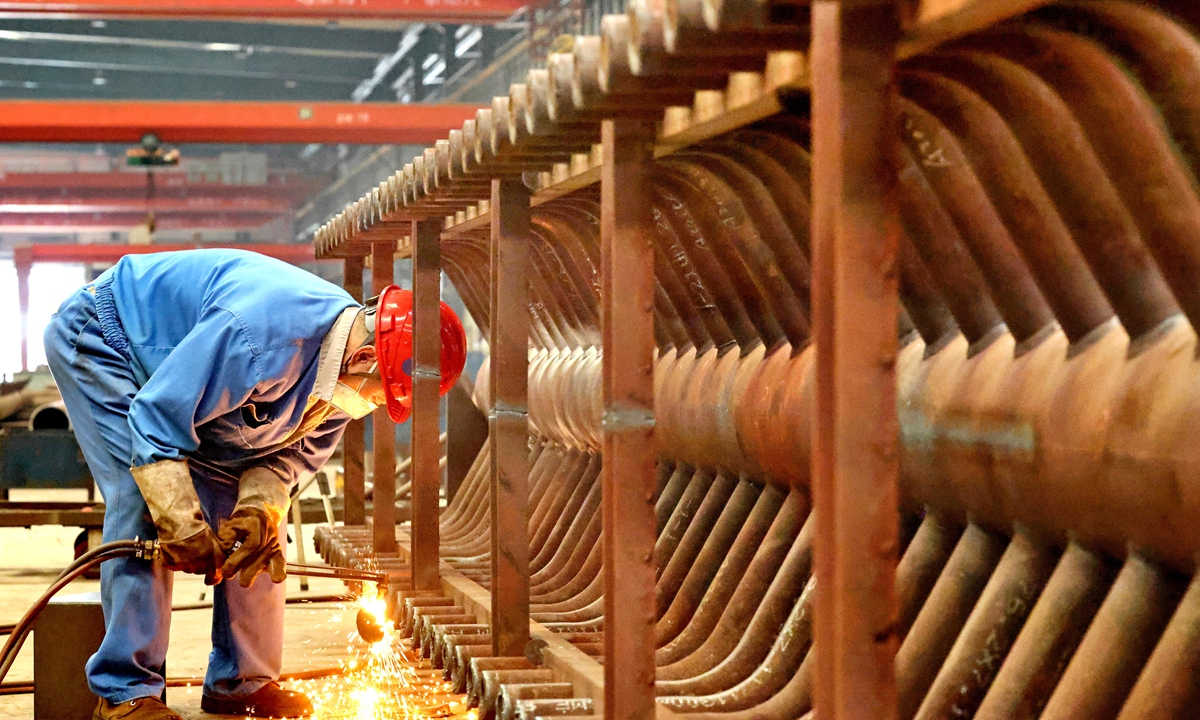
A worker fulfills orders for energy-saving and environmentally friendly boilers destined for export in a manufacturing enterprise in Nantong, East China's Jiangsu Province on August 4, 2026. The enterprise offers products including industrial waste disposal equipment, with sales to more than 30 countries and regions. Photo: CNS PhotoIn recent years, some economies, anxious about their own industrial competitiveness and market position, have politicized economic and trade issues, taking turns to hype false narratives such as "China overcapacity" and a "China Shock 2.0," and using them as pretexts to roll out protectionist measures.
But what are the facts on the ground?
China's Ministry of Commerce recently released a document titled China's Position on the So-Called Excess Capacity Issue. Reviewing the evolution of the global capacity landscape from a historical perspective, it offers an objective analysis of how industrial subsidies, trade surpluses, economic imbalances and market competition relate to "overcapacity," sets out China's policy practices and the direction of its efforts, and puts forward China's ideas and proposals - a forceful response to the "China overcapacity" narrative.
Plainly, the argument that "China's inadequate domestic demand gives rise to excess capacity" rests on a logical sleight of hand - it takes a localized phenomenon at the micro level of the market and applies it wholesale to the structure of the macroeconomy, a picture far removed from reality.
China is not only a major manufacturing power but also a major consuming power. Domestic demand has long been the main engine of the Chinese economy.
To see through the logical fallacy of the "overcapacity" narrative, one must first be clear about where the Chinese economy actually sits in the global landscape.
In the course of economic globalization, China has actively integrated itself into the international division of industrial labor and become the "world's factory" in the truest sense. Chinese manufacturing has enriched the global supply of goods, lowered living costs for consumers in countries around the world, and played an important part in easing global inflationary pressure. But to define China simply as a "producer" on that basis, and from there to conclude that it suffers from "inadequate domestic demand and overcapacity," is a proposition that does not hold water.
From 2013 to 2024, domestic demand contributed an average of 93 percent to China's economic growth, with consumption and investment accounting for an average of 55 percent and 38 percent respectively. China's total retail sales of consumer goods rose from 23.8 trillion yuan ($3.53 trillion) in 2013 to 50.1 trillion yuan in 2025, doubling in size.
Measured at the World Bank's purchasing power parity rates, China's total retail sales of consumer goods in 2025 were 1.7 times those of the US, making the country the world's largest market for consumer goods in all but name. China today ranks first globally in the physical volume of goods consumed, and its per capita annual consumption of some industrial products already approaches the levels seen in developed economies.
China keeps expanding its domestic demand and is working toward a higher-level balance between supply and demand.
Growth in China's total retail sales of consumer goods has slowed somewhat in recent years, and some have taken this as proof of weak domestic demand. That reading is neither objective nor complete.
A strong domestic market provides strategic support for Chinese modernization. The outline of China's 15th Five-Year Plan (2026-30) period devotes a dedicated part to building such a market, stressing the need to adhere to the strategic focus of expanding domestic demand, to expand effective investment, to further implement special actions to boost consumption, to promote the expansion and upgrading of commodity consumption, to unleashing the potential of service consumption, to strengthening the foundation of residents' consumption and to continuously improve the consumption environment - using new demand to guide new supply, and using new supply to create new demand, so as to promote a virtuous cycle between consumption and investment, and between supply and demand, achieve a higher level of dynamic balance between supply and demand.
The slowdown in retail sales growth is consistent with China's shift from high-speed growth to high-quality development, and it also reflects the upgrading of the country's consumption structure. China's consumer market is moving faster from one dominated by goods toward one in which goods and services carry equal weight. Spending on services is growing rapidly and is expected to account for more than half of the total by 2030.
China's super-sized market is not only the bedrock of its own development but also a broad platform on which countries around the world can share in the dividends of that growth.
China has ranked as the world's second-largest importer for 17 consecutive years and is a major export destination for nearly 80 countries and regions. It has granted zero-tariff treatment to 63 countries and regions, becoming the first major economy in the world to extend full zero-tariff coverage to every African country and every least developed country that has diplomatic relations with it. It is also the only country to host an international import expo, having staged eight editions of the China International Import Expo with cumulative intended deals worth more than $580 billion. Over the 14th Five-Year Plan period (2021-25) period, China's cumulative imports topped 90 trillion yuan. These facts and figures show clearly that China is not just the "world's factory" but, still more, the "world's market."
Looking ahead, China's middle-income group is set to exceed 800 million people within little more than a decade, and per capita GDP is expected to reach the level of a moderately developed country. With vast room for consumption and ample potential and vitality, domestic demand will remain the main engine of China's economic development and will keep injecting strong momentum into world economic growth.
This was compiled and translated by the Global Times English edition based on an article published in the "Chisu Jinsheng" economic commentary column of the People's Daily on August 6, 2026. 。政策赋能是这场变革的核心推力。早在2024年7月,杭州城发物流投用全市首批新能源渣土车,其中一台甲醇清洁能源车型挂上“0000”号绿牌。截至目前,该企业已累计投放200台新能源渣土车,投放规模领跑全市。企业的底气来自实打实的政策红利——2025年1月起施行的相关支持政策明确,通过购置补贴和运营补贴,单车最高可申领21.2万元;此外,新能源渣土车享有早晚高峰通行权限,政府投资项目招投标将新能源车辆保有量纳入评审指标,多维度降低运营成本。“以前柴油车采购价在35万至40万元,新能源车型虽贵了约20万元,但补贴直接拉低了购置门槛。”杭州城发物流董事长曹献稳算了一笔账:油价高位时柴油车每公里成本超3元,甲醇车每公里仅需2.16元;路权开放更直接带动司机增收——传统柴油车日均最多跑3至4趟,新能源车不受限行约束,日均最高可跑6至7趟。绿色转型的红利,更直观体现在城市治理效能的升级上。如今的新能源渣土车配备六路监控,数据实时接入监管平台,超载、疲劳驾驶等立即自动触发预警;全密闭货箱彻底解决了渣土遗撒、扬尘扰民等问题,市民相关投诉量明显减少;甲醇清洁能源车型加注仅需5分钟,续航可达600公里,进一步提升车辆运维效率。“以前见了渣土车就躲,现在这些绿牌车干干净净,沿途再也见不到扬尘了。”家住钱塘码头周边的市民感受十分真切。这场变革并不局限于渣土运输单一领域。目前杭州已构建起覆盖工程建设、环卫保洁、固废处置的完整低碳体系,新能源渣土车、环卫清扫车、生活垃圾清运车三类绿色作业车辆,已成为杭州街头的流动风景线——全市现有新能源环卫清扫车394台,占比15%;2026年3月投用的首批74台醇氢新能源生活垃圾清运车,较国六柴油车颗粒物(PM)排放下降98%、氮氧化物排放削减82%,且运行噪音更低。

二 | 按照规划,2027年底杭州生活垃圾清洁运输比例将提升至80%。接下来,杭州城管部门将持续深化政策配套、完善补能基础设施,助力杭州打造绿色低碳发展新高地。市综合行政执法局供图。

三 |
Current article:http://q7y.zhuaicaisaanzhenshunnaiwei.bond/tgu1y9/20260826/39898.html
Published on:17:45:23